The short version
- Delrin rear shackle bushings use a greaseable liner to reduce binding as the leaf spring moves.
- The setup can make spring movement more consistent and limit side-to-side rear-end movement.
- Delrin costs more than rubber and may increase noise, vibration and harshness.
Replacing OEM-style rubber rear shackle bushings with Delrin-lined units can reduce binding in a leaf-spring suspension and make the spring rate more consistent.
A rear shackle lets the leaf spring change length as it compresses and extends. Its two bushings allow that pivoting motion; without the shackle, the spring cannot move through its travel. Rubber bushings can wear over time, leading to binding, deflection and loose spring movement.
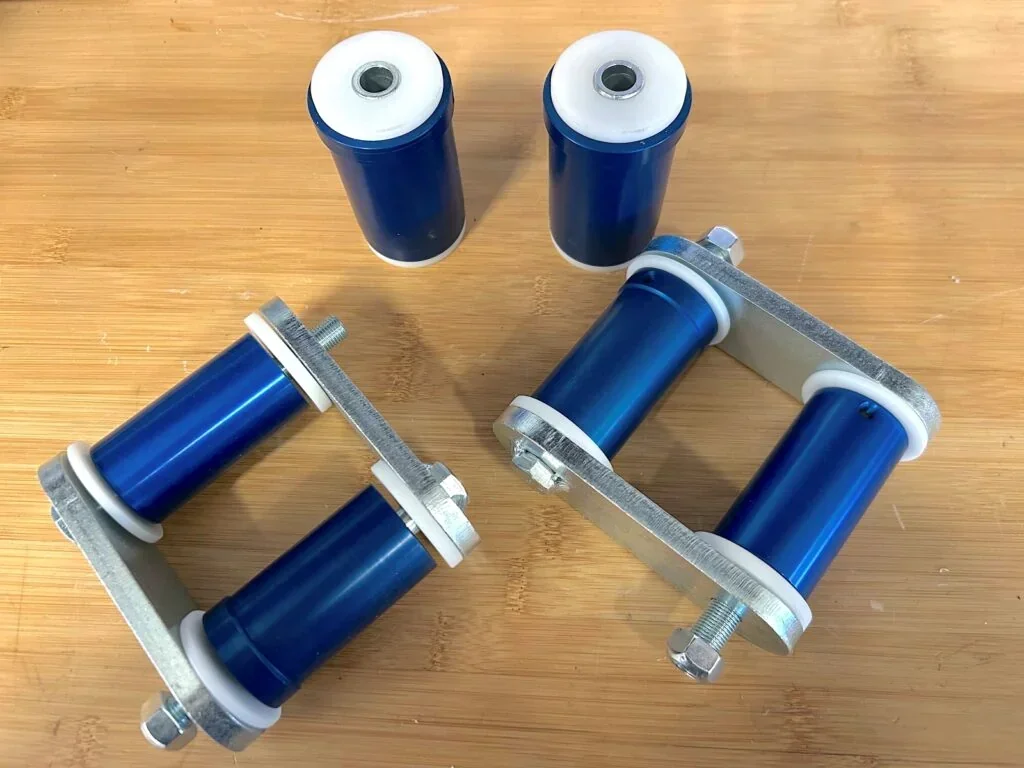
The Delrin setup uses a billet aluminum outer body, a steel inner sleeve and a greaseable Delrin liner between the two. Nothing is bonded together, so the liner can move on the sleeve while the shackle keeps its original travel.
Using Delrin bushings at both the front spring eye and rear shackle can make the shocks the primary suspension tuning adjustment, because the bushings deflect less than rubber. The stiffer arrangement can also limit side-to-side leaf-spring movement and, in some cases, reduce the need for a Panhard bar or Watts linkage on circle-track and road-race cars.
The tradeoffs are higher cost and potentially more noise, vibration and harshness. Delrin can become hard and brittle in sub-zero temperatures and may shatter under an extreme shock load, such as a severe pothole impact.
How this story was made
Written by the Tach Wire desk from the reporting below, checked against each source and for overlap with their text. Photos: OnAllCylinders.
0 comments
Comments stay in this browser. They are not sent to the newsroom.